Night and darkness
Journey to the End of the NightNight and darkness are more than a setting in the novel: they are the conditions under which fear overtakes speech, people must rely on one another, and the boundary between the living and the dead becomes unstable. In the Zone, darkness makes a desperate plan harder to retreat from or reveal; above Paris, it briefly gathers the dead into a vast, unruly procession that daylight cannot hold.
The Zone: fear, secrecy, and dependence
In the quiet of his dispensary, with night settled over the Zone, Ferdinand Bardamu listens as Abbé Protiste explains the efforts to find an inexpensive religious institution for Grandma Henrouille and Robinson. The hush makes the priest’s disclosures seem monstrous to him, and he wonders whether the echoes he senses are in the room or only in his own head. Night here is not simply a lack of light: it intensifies the burden of what is being said and makes ordinary conversation feel dangerous.
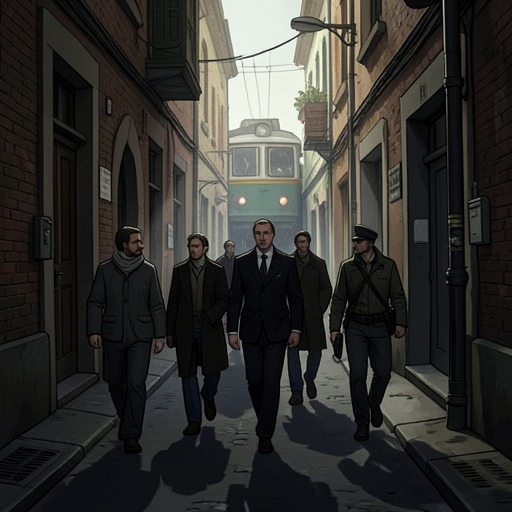
The plan brings the group into a shared darkness, both literal and moral. Bardamu describes the four people making their way together, holding hands, with Madame Henrouille holding the old woman and her son and Bardamu holding on to them and Robinson. Their course cannot readily be reversed: the law seems to be waiting around every corridor, and the group understands itself as implicated together. Darkness makes this dependence practical—without joined hands they may fall—and binds them to a course they have already begun.
The priest is newly drawn into their fear and asks how many people are involved and where they are going, hoping to move toward the same goal as the others. Bardamu tells him that if they meet passers-by they must pretend to be out for a walk. The instruction to act naturally exposes how little protection ordinary social behavior now offers: they have to perform normality precisely because they have left the safety of accepted society. Protiste’s ardent handshake and uncertainty mark him as a beginner in this shared predicament, while cautionary words passed between the group fail to reassure them. Fear absorbs what they say and think.
Darkness as a condition without return
For Bardamu, looking hard into the night cannot restore vision or control. Darkness has, in his account, taken even the light from their eyes; there is no road or illumination to guide them, only warnings whose comfort they do not truly believe. Yet joining hands remains necessary. The scene’s tension lies in this contrast: the characters cannot see where they are going, but they cannot proceed alone.
Bardamu gives the night a stark existential meaning. The group must either reach the end together or fail together; they may discover what their adventure was seeking, or find nothing. He describes life as a little light that ends in darkness, and the possibility of finding nothing as death. This is not a promise that darkness reveals a hidden answer. It is the possibility that the search ends without one, making the group’s forward movement a passage under conditions of uncertainty rather than a journey toward assured knowledge.
The practical urgency of the plan reinforces that uncertainty. Protiste is supposed to find homes for Grandma Henrouille and Robinson, but the religious institutions have waiting lists stretching months into the future, and the group is tired of waiting. His alternative scheme involves persuading Robinson to go south, and Bardamu agrees to help before he understands the full design. In the night, haste and fear narrow the room for judgment: Bardamu recognizes that he might have protected his friend by questioning the proposal, yet promises to cooperate and keep silent.
The dead over Paris
Elsewhere, darkness frames a vision in which the dead appear above the city. Bardamu recognizes Bébert among them and exchanges a signal with him; he also sees the pale girl from Rancy, along with former patients and other dead people whose lives he had only intermittently remembered. The gathering brings back the people whom the living city has lost from view. Their appearance makes remembrance belated: Bardamu feels the weight of not having had time to notice them properly while they were alive beside him.
The procession gathers disparate histories into one night sky. Among the figures are a man who had been lashed in Topo, Lieutenant Grappa, and a priest whose golden crucifix complicates his passage through the clouds. The dead include Communards still marked by the memory of conflict, and La Pérouse, who leads the gathering despite struggling with his backward wooden leg and the absence of his spyglass. The details resist a solemn, orderly afterlife. The assembly is awkward, unruly, and crowded with people whose pasts have not been erased by death.
The movement escalates when the ghosts surge across the sky in a rush associated with heroic battles. They pursue and charge one another across centuries, turning night into a field where successive histories collide. At last the horizon opens and day rises through the tear made in the darkness. The change of light does not settle the past; it makes the dead harder to find. Their brief visibility depends on a darkness that both conceals them and allows them to appear.
Remembrance, distance, and the limits of light
The vision also makes absence legible through the people who do not appear. Bardamu looks for Molly among the dead and does not find her; he imagines that her kindness has earned her a heaven apart from the disorderly company gathered over the city. Her absence distinguishes private gratitude from the general crowd of ghosts and gives the vision a personal point of tenderness without making it a universal revelation.
After daybreak, finding the dead requires getting outside Time, and even then the view shifts toward England, where fog rises in dense layers and rain and mist keep interrupting it. A red-haired woman stands on the island as its last nearly living presence, her hair contributing a little gold to the clouds; she is trying to make herself a cup of tea. The image carries the passage from the immense, tumultuous gathering over Paris to a remote, diminished remnant. Darkness and obscurity do not disclose everything. They make certain lives perceptible for a moment, then leave the observer with distance, weather, and the persistent work of remembering.